
When buying, developing, refinancing, or managing commercial property, understanding potential environmental liabilities is an important part of the due diligence process. Environmental contamination can affect property value, financing, redevelopment plans, regulatory obligations, and future cleanup costs.
Environmental Site Assessments (ESAs) help property owners, buyers, lenders, developers, and investors identify and evaluate potential environmental concerns. Two of the most commonly used assessments are the Phase I Environmental Site Assessment (Phase I ESA) and Phase II Environmental Site Assessment (Phase II ESA).
Although they are part of the same environmental due diligence process, Phase I and Phase II ESAs have different purposes. A Phase I ESA primarily investigates whether potential environmental concerns exist, while a Phase II ESA uses sampling and laboratory analysis to investigate suspected contamination.
Understanding when each assessment is appropriate can help stakeholders identify environmental risks before completing a transaction or moving forward with a development project.
What Is an Environmental Site Assessment?
An Environmental Site Assessment is a systematic evaluation of a property’s current and historical environmental conditions. It is commonly used to identify potential contamination and environmental liabilities associated with a property.
ESAs are frequently performed during:
- Commercial and industrial property acquisitions
- Real estate transactions
- Property refinancing
- Industrial facility purchases
- Brownfield redevelopment
- Facility expansion projects
- Corporate mergers and acquisitions
- Property portfolio assessments
The appropriate level of assessment depends on the property’s history, current use, environmental conditions, and the concerns identified during the investigation.
What Is a Phase I Environmental Site Assessment?
A Phase I ESA is a non-intrusive environmental investigation designed to identify potential environmental concerns associated with a property.
It generally involves reviewing available records, researching the property’s historical uses, inspecting the site, and evaluating information from relevant regulatory databases.
A Phase I ESA does not normally involve collecting soil, groundwater, or other environmental samples.
The investigation is intended to determine whether conditions exist that may warrant further environmental investigation.
Key Components of a Phase I ESA
Property Site Inspection
An environmental professional conducts a visual inspection of the property and surrounding areas to identify conditions that could indicate environmental concerns.
Depending on the property, observations may include:
- Aboveground or underground storage tanks
- Chemical storage areas
- Waste storage or disposal areas
- Stained soil or pavement
- Drums or containers
- Industrial equipment
- Evidence of spills or releases
- Potential environmental concerns on neighboring properties
Historical Records Review
Historical research helps determine how the property was previously used and whether past activities could have resulted in environmental contamination.
Records may include:
- Historical aerial photographs
- Sanborn fire insurance maps
- Historical directories
- Property records
- Previous environmental reports
- Land-use information
A property’s historical use can be particularly important when the site previously contained manufacturing, industrial, fueling, dry-cleaning, waste disposal, or other activities involving potentially hazardous substances.
Regulatory Database Review
The consultant reviews relevant environmental databases to identify known or suspected contamination, regulatory listings, reported releases, permits, or enforcement information associated with the property and surrounding area.
Interviews
Interviews with current or former property owners, occupants, operators, facility managers, or other knowledgeable parties may provide additional information about historical activities and environmental conditions.
Phase I ESA Report
The findings are compiled into a report that documents the investigation and identifies relevant environmental conditions.
A Phase I ESA may identify a Recognized Environmental Condition (REC) or other conditions that require additional consideration.
Need Help Determining the Right ESA for Your Property?
Get professional guidance on Phase I and Phase II Environmental Site Assessments to identify potential environmental concerns and determine the appropriate next steps for your property.
What Is a Recognized Environmental Condition?
A Recognized Environmental Condition, or REC, generally refers to the presence or likely presence of hazardous substances or petroleum products in, on, or at a property due to a release, likely release, or material threat of a future release into structures or the environment.
The identification of a REC does not automatically mean that contamination has been confirmed.
Instead, it indicates that additional evaluation may be appropriate to determine whether an environmental concern actually exists and what further action may be necessary.
Examples of conditions that could warrant further investigation include:
- A documented release from a storage tank
- Historical industrial operations
- Evidence of chemical handling
- Previous waste disposal activities
- Reported spills
- Potentially contaminated neighboring properties
What Is a Phase II Environmental Site Assessment?
A Phase II ESA is an intrusive environmental investigation that may be conducted when a Phase I ESA or other information indicates a potential environmental concern.
The primary objective is to determine whether contaminants are present and, where appropriate, evaluate their concentrations, distribution, and potential impact.
Unlike a Phase I ESA, a Phase II investigation involves field sampling and laboratory analysis.
Key Components of a Phase II ESA
Soil Sampling
Environmental professionals collect soil samples from locations selected based on the suspected source or type of contamination.
Testing may help determine whether contaminants are present and whether additional investigation is necessary.
Groundwater Sampling
Where groundwater may be affected, monitoring wells or other appropriate methods may be used to collect samples for laboratory analysis.
Groundwater investigations can help determine whether contamination has migrated beyond the suspected source area.
Soil Vapor Investigation
For properties where volatile contaminants may be a concern, consultants may conduct soil vapor investigations to evaluate whether vapors are present beneath or near buildings.
Laboratory Analysis
Environmental samples are submitted for laboratory testing to identify and quantify contaminants relevant to the site and investigation objectives.
Data Evaluation
Laboratory results are evaluated against applicable regulatory criteria or screening levels to determine whether additional assessment or response actions may be warranted.
Phase II ESA Report
The final report documents the investigation methodology, sampling locations, laboratory results, data interpretation, and recommendations for potential next steps.
Phase I ESA vs Phase II ESA: What's the Difference?
The main difference is the purpose and level of investigation.
| Feature | Phase I ESA | Phase II ESA |
|---|---|---|
| Primary purpose | Identify potential environmental concerns | Investigate suspected contamination |
| Site inspection | Yes | May be included |
| Historical research | Yes | Uses Phase I findings |
| Regulatory database review | Yes | Uses existing information |
| Soil sampling | No | Yes, when applicable |
| Groundwater sampling | No | Yes, when applicable |
| Laboratory testing | No | Yes |
| Intrusive investigation | No | Yes |
| Typical trigger | Due diligence or property transaction | Potential concern identified |
| Relative cost | Generally lower | Generally higher |
| Typical timeframe | Generally shorter | Generally longer |
In simple terms, Phase I asks, “Could there be an environmental concern?” while Phase II asks, “Is contamination present, and what does the available data tell us about it?”
The exact scope of either assessment should be determined based on the property’s circumstances and applicable standards.
When Is a Phase I ESA Needed?
A Phase I ESA is commonly conducted as part of environmental due diligence when a property is being purchased, financed, developed, or otherwise evaluated for potential environmental liabilities.
Commercial Property Acquisition
Buyers may commission a Phase I ESA before completing a commercial property transaction to identify potential environmental concerns associated with the property.
Industrial Property Transactions
Industrial properties can have more complex environmental histories because of previous manufacturing processes, chemical use, storage activities, waste handling, or other operations.
Commercial Lending
Lenders may require environmental due diligence as part of evaluating a commercial property that will serve as collateral.
Property Redevelopment
Developers can use Phase I ESAs to identify potential environmental issues before investing in redevelopment or construction activities.
Business Acquisitions
Environmental due diligence may form part of a broader investigation when companies acquire businesses, facilities, or property portfolios.
Liability Evaluation
A properly conducted Phase I ESA can provide important information for evaluating potential environmental liabilities and may support certain protections available under applicable federal law when regulatory requirements are met.
When Is a Phase II ESA Needed?
A Phase II ESA is generally considered when available information indicates that additional investigation is necessary.
A Phase I ESA Identifies a Potential Concern
If the Phase I investigation identifies a REC or another condition requiring further evaluation, a Phase II ESA may be recommended.
Historical Industrial Operations Are Present
Properties with histories involving manufacturing, chemical processing, petroleum storage, metalworking, dry cleaning, or waste handling may warrant additional investigation depending on the specific site conditions.
Evidence of a Release Exists
Known or suspected spills, leaks, or releases may justify sampling to determine whether contamination is present.
Regulatory Requirements Apply
A regulatory agency may require additional investigation or environmental characterization depending on the property’s circumstances.
Redevelopment Plans Could Disturb Contaminated Areas
Construction, excavation, or other redevelopment activities may require a better understanding of subsurface environmental conditions before work begins.
Buyers or Lenders Need Additional Certainty
Stakeholders may request additional environmental investigation to better understand potential liabilities before completing a transaction.
Does Every Phase I ESA Lead to a Phase II ESA?
No.
A Phase II ESA is not automatically required after every Phase I ESA. The decision depends on the findings of the Phase I investigation, the nature of identified environmental conditions, regulatory considerations, the property’s history, and the objectives of the parties involved.
In some cases, a Phase I ESA may identify no conditions requiring additional investigation. In other situations, further assessment may be appropriate.
A qualified environmental professional can help determine whether additional investigation is warranted based on the available evidence.
Why Environmental Due Diligence Matters
Environmental due diligence can help organizations identify potential liabilities before they become unexpected financial or operational problems.
Unidentified contamination can potentially result in:
- Cleanup expenses
- Transaction delays
- Financing complications
- Regulatory requirements
- Property value concerns
- Construction delays
- Legal liabilities
- Additional investigation costs
Environmental due diligence is particularly important for organizations acquiring or operating industrial properties where historical activities may create additional environmental considerations.
For manufacturers, environmental site assessments should also be considered alongside broader regulatory compliance activities. Maintaining a comprehensive manufacturing environmental compliance checklist can help organizations monitor permits, inspections, reporting obligations, waste management practices, and other environmental responsibilities.
This broader approach can help connect property-level environmental due diligence with ongoing facility compliance.
Environmental Due Diligence for Multi-State Operations
Environmental requirements can become more complex when an organization owns or operates properties in multiple states.
Different jurisdictions may have their own environmental programs, reporting requirements, cleanup standards, permitting processes, and regulatory expectations.
Organizations evaluating properties across multiple locations should therefore consider environmental due diligence within the context of their broader compliance program.
Understanding multi-state environmental compliance can help organizations coordinate environmental responsibilities across facilities and identify differences in regulatory requirements when expanding or acquiring properties.
Who Typically Requests an Environmental Site Assessment?
ESAs can be useful to a range of stakeholders, including:
- Property buyers
- Commercial lenders
- Real estate developers
- Investors
- Industrial property owners
- Corporate acquisition teams
- Attorneys
- Government entities
- Property managers
The objectives can vary between stakeholders. A buyer may want to understand potential liabilities, while a lender may need environmental information for financing decisions.
How an Environmental Compliance Consultant Can Help
Environmental Site Assessments require specialized knowledge of environmental regulations, property history, investigation methods, and environmental risk.
An experienced environmental compliance consultant can help organizations evaluate their environmental responsibilities and coordinate appropriate due diligence activities.
Depending on the project, professional support may include:
- Phase I ESA coordination
- Phase II investigation planning
- Environmental records review
- Site inspections
- Sampling strategy development
- Regulatory research
- Environmental risk evaluation
- Regulatory agency coordination
- Environmental reporting
- Remediation planning support
The appropriate scope depends on the property’s characteristics, transaction objectives, and environmental concerns identified during the investigation.
How to Choose the Right ESA for a Property
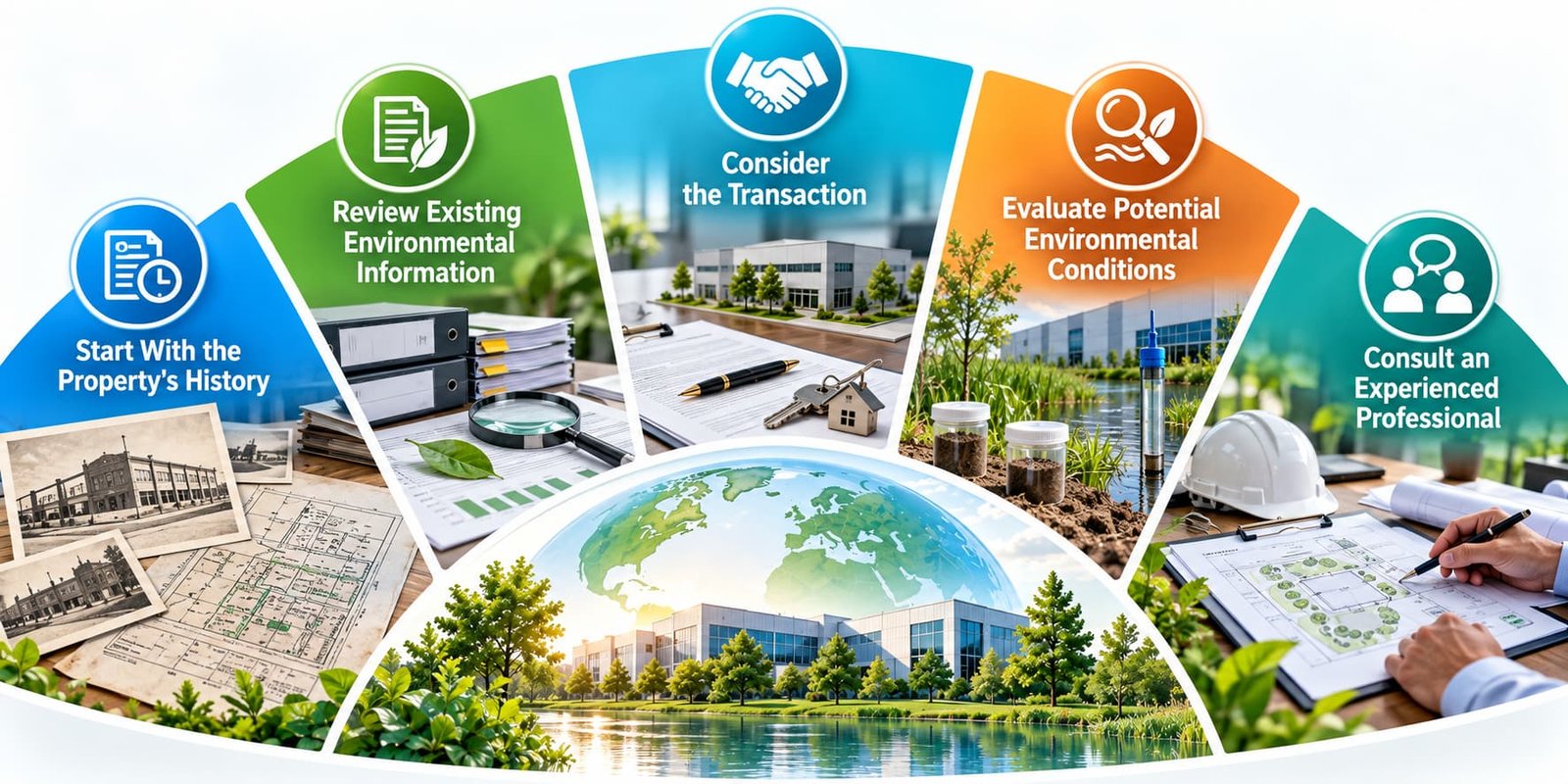
The appropriate assessment depends on the questions that need to be answered.
Consider:
Start With the Property’s History
Understanding previous uses can help identify whether potential environmental concerns warrant further evaluation.
Review Existing Environmental Information
Previous assessments, regulatory records, permits, spill reports, and other available information can help establish the property’s environmental history.
Consider the Transaction
The level of environmental due diligence may differ depending on whether the property is being purchased, refinanced, developed, leased, or evaluated as part of a corporate transaction.
Evaluate Potential Environmental Conditions
If a Phase I ESA identifies a potential concern, additional investigation may be appropriate.
Consult an Experienced Professional
Environmental professionals can help determine an appropriate investigation strategy based on site-specific conditions and applicable standards.
Conclusion
Phase I and Phase II Environmental Site Assessments serve different but complementary purposes within environmental due diligence.
A Phase I ESA is primarily a non-intrusive investigation used to identify potential environmental concerns through historical research, regulatory database reviews, interviews, and site observations. A Phase II ESA goes further by using intrusive investigation, environmental sampling, and laboratory analysis to evaluate suspected contamination.
Not every property requires a Phase II ESA. Whether additional investigation is appropriate depends on the findings of the Phase I assessment and other site-specific factors.
For buyers, developers, lenders, investors, and property owners, understanding the difference between Phase I and Phase II ESAs can make environmental due diligence more structured and help identify potential issues before they affect a transaction or development project.
For organizations managing manufacturing facilities, combining property-level due diligence with a manufacturing environmental compliance checklist can provide a more comprehensive approach to environmental risk management. Companies operating across several jurisdictions should also consider the requirements associated with multi-state environmental compliance when evaluating environmental responsibilities across their property portfolio.
Frequently Asked Questions
How long does a Phase I ESA typically take?
The timeframe varies depending on the property’s size, complexity, records availability, site history, and scope of work. Many Phase I assessments can be completed within a few weeks, but more complex properties may require additional time.
Does every property require a Phase II ESA?
No. A Phase II ESA is generally considered when a Phase I ESA or other available information identifies environmental concerns that require additional investigation.